Agree what “recovered” means
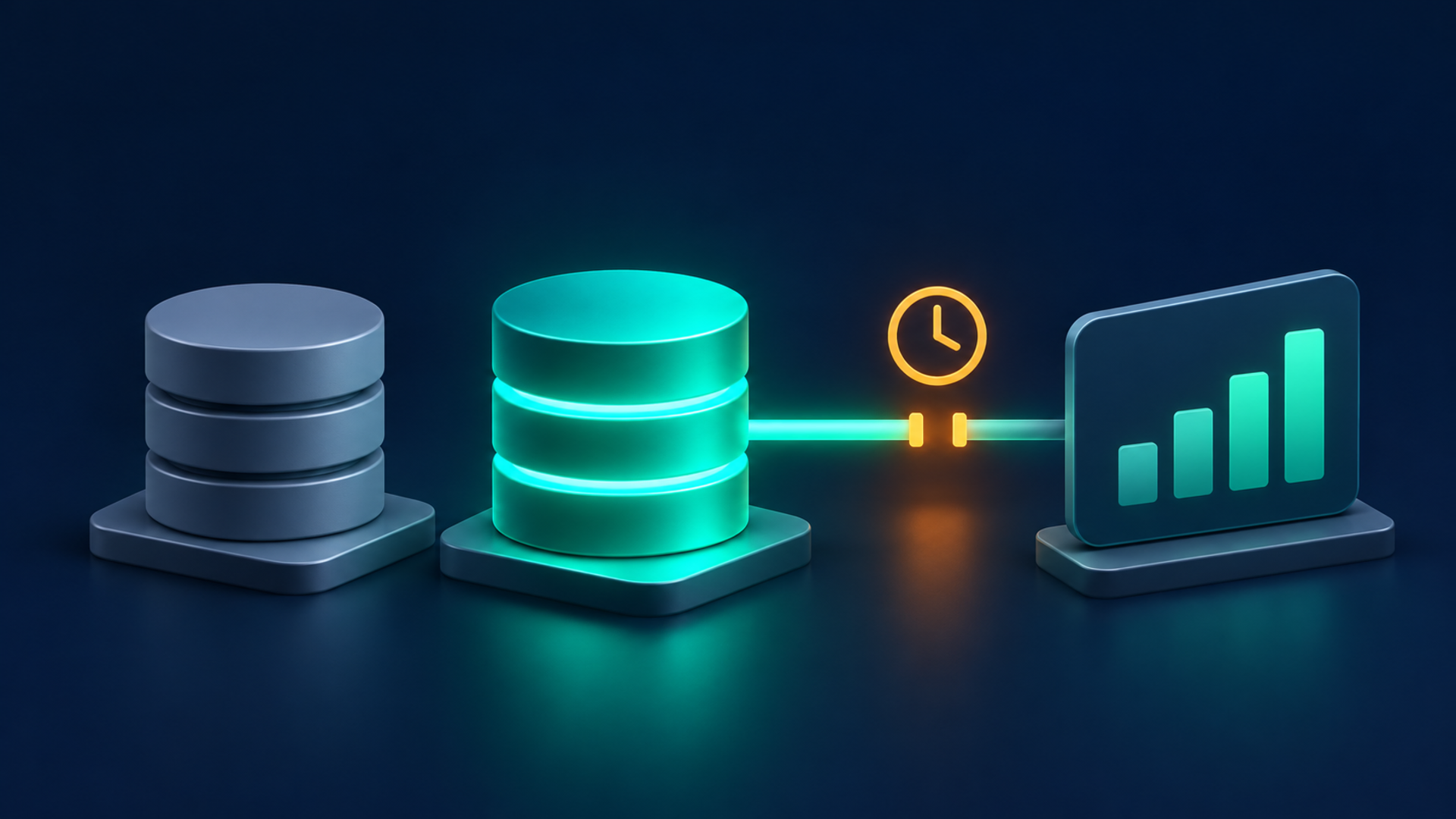
Set separate acceptance criteria for transaction processing and analytics. A warehouse connection or a successful query is too narrow a test of whether a stock decision, operational report or downstream job has current information.
Agree the maximum acceptable age of data for each important consumer, who can pause it, and who authorises its restart. Where older figures remain useful, show their last verified freshness time and a clear warning. Where stale figures could trigger an unsafe business action, pause the consumer until validation passes.
Keep data loss and data delay separate. AWS distinguishes a planned switchover, which synchronises before promotion, from an unplanned failover that can lose transactions because global replication is asynchronous. A newly synchronised warehouse reflects the promoted source; it does not prove that every pre-outage transaction survived.
Automate reconciliation, then finish recovery
AWS’s 11 November 2026 sample uses EventBridge to detect a completed global transition and Lambda to discover the current writer. The function checks live global-cluster topology rather than treating an event as definitive evidence of which cluster is now primary. Its regional copies act only in the writer’s Region.
The sample recreates the integration against the promoted source and its local Redshift target, cleans up integrations carrying its ownership tags, and updates replication alarms for the replacement integration ID. It serialises regional invocations and rechecks state to handle duplicate deliveries. These are documented sample safeguards, not results from a deployment tested for this article.
The automation leaves two important handovers. Once the replacement integration is active, an operator creates a Redshift destination database from its new integration ID. For Aurora PostgreSQL, that command also identifies the source database. AWS’s Redshift documentation confirms that replication into the destination database requires this creation step.
Next, wait for selected tables to synchronise, validate new writes and redirect analytics clients to the correct regional target and destination database. The sample does not route analytics queries. Give database creation, validation and routing explicit owners rather than assuming the integration function completes the whole recovery.
Prepare every possible primary Region
Aurora zero-ETL requires its source and target to be in the same AWS Region. In this recovery design, every Region that could become primary therefore needs a suitable local Redshift target. Include that regional capacity in the design and cost review.
For the PostgreSQL walkthrough, AWS requires the replication parameter group on every member cluster, with required reboots completed before recovery is needed. It also calls for local target authorisation, target case sensitivity and appropriate regional encryption configuration. Check supported engine versions and Regions against current AWS guidance before implementation.
Data selection needs the same attention. Aurora PostgreSQL requires a data filter covering at least one database, UTF-8 source databases and primary keys on selected tables. After an unplanned failover, verify that the promoted source contains the objects you intend to replicate. Treat an active integration with failed or missing required tables as incomplete recovery.
Rehearse from write to report
Use a controlled, production-representative rehearsal before relying on the pattern. A planned switchover provides a starting point, but it does not reproduce every failure mode of a regional outage. The following is a proposed test, not a record of completed measurements.
- Record the existing source, integration ID, target and destination database. Agree the freshness limit, recovery deadline and consumer restart criteria.
- After promotion, confirm the actual writer and replacement integration. Record when the create request is accepted and when the integration becomes active.
- Create the destination database from the new ID. Check SVV_INTEGRATION and SVV_INTEGRATION_TABLE_STATE in the intended target; resolve failures affecting required tables.
- Write a uniquely identifiable test record to the promoted source. Track it through the destination and the real report or job, including any refresh or cache boundary.
- Record when consumers resume with verified fresh data. Test the return direction too, including its new integration ID, destination database and routing change.
Budget for reseeding and operator recovery
Recreation starts an initial synchronisation. AWS warns that seeding time depends on the data and environment; Lambda finishing is not evidence that the warehouse is current. A switch over and switch back creates two reseeds in the sample design. Measure source I/O, target consumption, synchronisation time and the full consumer interruption before agreeing a rehearsal schedule or recovery commitment.
Compare a manual runbook with event-driven recreation using the same acceptance test. Manual recovery may suit a team that can reliably meet its agreed recovery window; automation removes some steps but still needs maintained permissions, regional configuration, alerts and a rehearsed operator handover. Neither option removes the reseed or the need to validate consumers.
Include incomplete readiness in the exercise. AWS’s sample stops before cleanup if the promoted cluster has no available writer instance. Its retries are bounded; an operator may need to create the instance and replay the failed event. During regional impairment, cleanup of the old integration can also be incomplete and require later reconciliation.
Monitor automation errors, exhausted retries, integration lag and failed-table counts. The sample updates replication alarms because replacement integrations receive new IDs. Also verify that notifications reach an accountable person, and use the consumer freshness test to decide when normal business processing can resume.
Start with one critical report and assign an owner to each recovery handover. The useful deliverable is a runbook with observed timings, costs and pass criteria from your own environment. No recovery duration, cost saving or production outcome has been measured for this draft.
Frequently asked questions
Does Aurora global failover restore zero-ETL automatically?
AWS currently documents that a zero-ETL integration becomes inactive after its primary source cluster fails over to a secondary. Recovery requires deleting and recreating the integration. AWS’s sample automates recreation, but destination database creation, validation and analytics routing still need explicit recovery steps.
Can the promoted source use the old Region’s Redshift target?
Aurora zero-ETL requires the source and target to be in the same Region. AWS’s global recovery pattern therefore uses a local Redshift target in each possible primary Region, with a separate mechanism to route analytics clients.
Is an active integration enough to restart reports?
No. AWS requires a destination database created from the integration before replication into that database can begin. Its recovery walkthrough also checks selected-table synchronisation before routing clients. Add a new-write check through the actual report as your own acceptance test.
How long should analytics recovery take?
There is no universal duration for this recovery pattern. AWS identifies initial synchronisation as workload-dependent. Measure the interval through database creation, table synchronisation, consumer routing and verified fresh results in your environment before setting a recovery commitment.